Showing posts with label History. Show all posts

Wednesday, June 29, 2011

Known and Unknown: A Memoir by Donald Rumsfeld

832 pages
Published by Sentinel, a Penguin Group in 2011
New York, NY


"My life has spanned more than one third of the history of the United States. As I thought more about this memoir and a title, the idea of the known and the unknown seemed to fit. Not only are there things in this book people believe they known about my life, but there are also things that may surprise and differ from what many may have read or heard or assumed." ~ Donald Rumsfeld

From the first moment I heard about Donald Rumsfeld's memoir, Known and Unknown I wanted to read it. What could be more fascinating than learning the "inside story" of my country's government for the last forty years than from a man who has spent most of his life serving as a Congressman, an Ambassador, and even twice as Secretary of Defense?

Most readers of my generation will of course remember Mr. Rumsfeld as the Secretary of Defense for most of George W. Bush's presidency, but what many of these same people may not realize is that that was not his first appointment to the job. Donald Rumsfeld also served as Secretary of Defense during the Ford administration in 1975. By 2001 he had been both the youngest and oldest person in American history to be appointed to the job of Secretary of Defense. Fascinating...

And that is exactly how I found Known and Unknown, fascinating. I was only 100 pages into the tome (and tome it is, for the text, index not included, reaches well over 700 pages!) and I could hardly put the book down.

During approximately the first quarter of Known and Unknown, Mr. Rumsfeld discusses in some detail the years 1932-1969 -- from his childhood, to the time spent serving in the US Navy, and later as a 29 year-old US Congressman from Illinois. For me this part of the book was a quick history lesson. Some events and people mentioned I remember hearing about, but for the most part his memoir filled in many of the holes left over from my childhood history lessons.

The second quarter of the book recalls Mr. Rumsfeld's time serving as a representative to NATO and White House Chief of Staff during the 1970s, as well as brief mention of the two decades he worked in the private sector for pharmaceutical companies. Again, the mention of people, places and events filled in more of the holes in my personal world and American history knowledge. By the end of the first half of Known and Unknown, Mr. Rumsfeld has brought his story up to the late 1990s, a time in which I have personal memories and the starting point of what I consider "recent history."

The "meat" of Known and Unknown is certainly to be found in the last half of the book. It is in this last half that Mr. Rumsfeld reaches the end of the 20th century and the early years of the 21st. It is a time that I consider "recent history" and to a point "current events." It is a time I remember vividly. Some events I remember reading or hearing about in the news and other events I experienced personally. For me the last half of Known and Unknown was the most fascinating section of the book... And at times it was also quite overwhelming. I was blown away with the amount of detail contained in each chapter. I can only imagine the amount of time and the extent of research that was required to complete this memoir. And I challenge anyone who thinks they know the reasons why America was attacked on 9/11 and why America went to war in Iraq and Afghanistan to read this book. This is not just one man's view, this is a memoir that includes details, facts, quotations, citations, and references that explain the known and the unknown of that period. It was very interesting.

That said, I must admit Known and Unknown is not for the faint of heart. If you tremble at the thought of reading anything political or historical in nature than you probably won't find Known and Unknown an easy read. Mr. Rumsfeld writes well, the entire book is woven together almost seamlessly, which makes it must easier to follow than other memoirs I've read, but the extent of detail does slow the reader down. If you have a predetermined interest in the topic then it is well worth the effort.

All in all, I am glad I took the time and effort to read Known and Unknown. While not every reader may agree with every decision made by Mr. Rumsfeld (or his bosses) I still encourage every reader to consider reading Known and Unknown, if for no other reason than to learn another side to the story that is recent American history.

------------------------------
Related Links:

Tuesday, March 29, 2011

Decision Points by George W. Bush

481 pages
Published in 2010
By Crown Publishers
New York, NY


"The nature of the presidency is that sometimes you don't choose which challenges come to your desk. You do decide how to respond." - George W. Bush
Decision Points is not your typical memoir, that is not if you're expecting a chronological retelling of George W. Bush's life. Instead, President Bush chose to focus on key decision points within his lifetime and by doing so, he presents a thorough picture of his background and what has made him the man he is today. Of course, because this is a presidential memoir it should come as no surprise that the majority of the book focuses upon decisions made during the eight years he served as President of the United States.

My thoughts:
Over the years I have found that some of the most fascinating reads are those written by or about people who have had a direct impact on the world in which I live, particularly books about American history and the American people. So it was with great interest and curiosity that I picked up President Bush's memoir, Decision Points. And I am happy to report that I was not disappointed.

From start to finish I found Decision Points to be a fascinating read of current events and recent history. We're not talking nitty-gritty gossip, but the key info as to the why and how President Bush made decisions, both personal and public.

If you think you already have the whole story when it comes to George W. Bush because you read the newspapers or watched the evening news, think again; there are always two sides to every story.

When making any decision I believe it is valuable to hear the "objective" outside view, but I also believe it is extremely valuable to include the perspective of the person on the "inside", the one making the decisions. One can read any number of books on the American Revolution, but to truly understand what life was like and why the Founding Fathers made the decisions they did one must read the personal writings of the founders, as well as books that detail their life and beliefs. In essence, until you learn what made them tick you cannot truly understand why they acted as they did. The same can be said of any modern statesman. Whether you agree with the person or not, you won't stand a chance of ever understanding why they act a certain way or believe a certain thing if you don't take the time to hear their point of view.

As far as the writing style, Decision Points is a easy read. Although President Bush addresses some complicated issues and details he doesn't let the reader get bogged down. His writing is simple, but intelligent and to the point. He says it like it is and doesn't mince words; even when admitting his own mistakes. He comes across as a humble man of faith; not at all one who plays pious or lives a life of hypocrisy. (One may wish me to note there was a smattering of profanity in the book, but always when quoting a previous conversation usually between one politician and another.) President Bush is mostly unapologetic about the decisions he made throughout his political and legislative career stating in the epilogue, "I knew some of the decisions I had made were not popular with many of my fellow citizens. But I felt satisfied that I had been willing to make the hard decisions, and I had always done what I believed was right." (pg. 474)

And that is actually what I admire most about President Bush. Regardless of what others think of his presidency or of him as a person, I personally admire that he took in all the facts, discussed and considered the options, and in the end always made the decision based on what he truly believed was right and good, not for his reputation or career, but for the country as a whole. He was a true example of a politician, one who serves the public not themselves.

Being president of the United States is quite an honor. Only 44 men have held the position in the last 222 years. You don't get on that list just because you want the job. Nor do you get there because you're popular. You get there because you have the experience, the courage, and the leadership to hold the position and you have earned the trust of millions of Americans. I hope those who read President Bush's memoirs do not read it with the goal to nitpick the past, but instead read it with an open mind so as to better understand the man who led the free world for the first eight years of this new millennium, through some of the most difficult decision points of American history.

In the end as President Bush points out within his memoir, history will be the final judge. If historians and critics can still mull over and argue about decisions made by our first president, George Washington 200+ years after his presidency ended, it will be some time before anyone comes to a final conclusion about the presidency of George W. Bush.

-------------
Related Links:

Random House Publishers: Decision Points

Kindle: Decision Points ($14.99)

George W. Bush Presidential Library

The White House: George W. Bush (#43)

Review: Spoken From the Heart by Laura Bush

Friday, March 25, 2011

A Tale of Two Cities by Charles Dickens

372 pages
Published in 2004 by
Barnes & Noble Books
New York, NY
(Originally published in 1859
by Chapham & Hall, London, England)

"It was the best of times, it was the worst of times, it was the age of wisdom, it was the age of foolishness, it was the epoch of belief, it was the epoch of incredulity, it was the season of Light, it was the season of Darkness, it was the spring of hope, it was the winter of despair, we had everything before us, we had nothing before us, we were all going direct to Heaven, we were all going direct the other way -- in short, the period was so far like the present period, that some of its noisiest authorities insisted on its being received, for good or for evil, in the superlative degree of comparison only." (Book 1, Chapter 1, pg 7.)
For years I have wanted to read A Tale of Two Cities by Charles Dickens, but just never made the time. And then, at the end of last year I determined I would not put it off another year, I would have the book read before the end of 2011! I asked the ladies in my book club if we could add it to our list of upcoming books to read, to which they readily agreed. This done, I started the book at Christmas with hope of having it read well before the scheduled time to discuss. Unfortunately my first attempt didn't turn out too well... I was sick over the holidays, under a lot of stress at work, and as a result completely unable to grasp what I was reading. So I set the book aside and waited a few weeks. At long last I picked it up again with new determination. And this time I succeeded!

The Plot:
A Tale of Two Cities is a historical romance written by one of English literature's best authors. The story is split between London and Paris during some of history's most explosive years -- the years leading up to and during the French Revolution and the "reign of terror." It is not only a tale of two cities, but it is a tale of two life choices -- the choice between good and evil, between compassion and tyranny, between selfless love and selfish hate. It is a powerful story of life.

My Thoughts:
A Tale of Two Cities is really told in the form of three sub-books. Book One: Recalled To Life sets the foundation of the story and as such does begin a little slow, but there are details here that become important to the reader much later in the book. While reading this part I found myself bogged down and felt clueless as to what was going on in the book. So, rather than give up I turned to Cliff Notes whenever I didn't understand a chapter or a scene, which greatly helped me get my reader's "feet" under me. So that by Book Two: The Golden Thread I was confident in what I was reading. It is at this point in the book that the story picks up the pace and the reader begins to see where the overall story is headed. This is also the portion of the book where Dickens focuses heavily on both the historical detail and the character development. Again, important details are tucked into the story that prove valuable in Book Three: The Track of a Storm. From this point on I could hardly put the book down, this is the climax of the story when all the details start to come together like pieces to a puzzle and at the very end the reader is left with the picture of the supreme sacrifice of selfless love and a powerful lesson for life.

A Tale of Two Cities is probably one of the best pieces of literature I have ever read. Yes, it's true and I am not alone. There were a dozen ladies at our book club discussion ranging in age, personality, and background, but every single one of the ladies read and loved A Tale of Two Cities. Yes, it is can be a difficult read, especially if you are unaccustomed to Dickens or 19th century literature, but it is a worthy read and one that every person should read.

I confess, if it wasn't for the ladies in my book club I do not know if I would have ever given Dickens a real chance. As a teenager I found him boring and too wordy for my liking. It was not until the book club read Great Expectations a few years back that I changed my mind. I joke now that I had no great expectations for Dickens, but that thanks to the ladies' encouragement I was able to finish the book and was thrilled to discover how wrong I had been. Since then I have gone on to read and enjoy Bleak House, Little Dorrit, and now A Tale of Two Cities.

So that brings me to you. If you have never read A Tale of Two Cities I exhort you to add it to your reading list for this year (or next). If you are like I was and have given Dickens a chance, but gave up, then I encourage you to give him another try. His writing is rich and will make you a better reader for the time you invest.

Here are some suggestions I have found helpful that might work for you:

1. Track down a copy of Cliff Notes or Spark Notes for the book you wish to read. No, this is NOT cheating, so long as you use it to aid with your reading of the actual book. While paperback copies of Cliff Notes are available in book stores, I find the free online versions to the best for my reading. The chapter summaries alone have helped me work through and appreciate some of the more difficult chapters in classic literature like A Tale of Two Cities by Charles Dickens or The Brothers Karamazov by Fyodor Dostoevsky.

2. Watch a good film adaptation. I'm not normally a fan of watching a movie before reading the book, but in some cases I think it's very valuable. I watched the 2005 Masterpiece Theater adaptation of Bleak House before I tackled the book and found it very helpful as I was then able to keep the plot threads, characters, and dialogue clear in my mind. I've yet to see any adaptation of A Tale of Two Cities, but I have been told the 1935 version with Ronald Colman is excellent and true to the book and that the 1980 version with Chris Sarandon is likewise good.

3. Listen to an audio version. I've been told that one of the best ways to read a difficult book is to have it read to you. Instead of stumbling over difficult words or being distracted by foot or end notes the listener can sit back and let their imagination go as they listen to the story unfold. While Cliff Notes or Spark Notes are probably better for the visually minded, the audio version is generally better for those who learn best through audio. I am a visual person so I often find myself distracted while listening to audio books, but for those who are more audio-minded an audio book can take you places you would never go if you had to read on your own.

4. Find a group that is interested in reading the same book as you, purpose to read it (alone or together) and then plan to discuss what you liked or didn't like and what you learned.

5. Last but not least, have patience. Reading classic literature often takes time. It's rare for readers to be able to rush through reading a classic as might be done with a piece of modern fiction. I liken reading classics to eating a steak vs. modern fiction, which is like a bowl of soup. Eating a steak requires time. You have to cut small pieces, chew them and then swallow, while soup requires only scooping a spoonful and swallowing it. When reading a classic, don't put unneeded pressure on yourself; pace your reading. And don't feel bad if it takes you a lot longer to finish than other books you read.

Reading is really like anything in life. There is a learning curve. It takes time, practice and determination, but if you desire you can learn to read any book you pick up and often you will find that you surprise yourself with what you end up enjoying.

Good luck and happy reading!

----------------------
Related Links:

Kindle: A Tale of Two Cities ($0.00)

Project Gutenberg: A Tale of Two Cities (ebook)

Lit2Go: A Tale of Two Cities (audio book with lessons)

Librivox: A Tale of Two cities (audio book)

Cliff Notes: A Tale of Two Cities

Spark Notes: A Tale of Two Cities

Book Reviews: Books by Charles Dickens

Charles Dickens Literature

Thursday, March 17, 2011

What is the real reason we celebrate St. Patrick's Day?

"For this sun which we see rises daily for us because He commands so, but it will never reign, nor will its splendour last; what is more, those wretches who adore it will be miserably punished. Not so we, who believe in, and worship, the true sun — Christ — who will never perish, nor will he who doeth His will; but he will abide for ever as Christ abideth for ever, who reigns with God the Father Almighty and the Holy Spirit before time, and now, and in all eternity. Amen." ~ Patrick's Confession
All About St. Patrick's Day

A Poem (Lorica) by St. Patrick


Thursday, November 11, 2010

Veteran's Day - In Rememberance

Did you know that today is Veteran's Day?

Do you think it is a forgotten holiday that should be canceled or one that should be remembered and honored? I read one article where the author claimed Veteran's Day was an insult to all soldier who served after the first World War. I don't happen to agree, but it is an interesting thought to consider.

Veteran's Day. Why do we celebrate? Most people don't even notice it since for many businesses it isn't associated with a day off work or a holiday sale like Memorial Day, Independence Day, or even Columbus Day are. It doesn't even bring on a flurry of gift cards and parties like Valentine's Day or St. Patrick's Day.

And speaking of Memorial Day, what exactly is the difference between that holiday and Veteran's Day? Why do we celebrate both? According to the Department of Veteran Affairs we celebrate "Memorial Day to honor service members who died in service to their country or as a result of injuries incurred during battle. Deceased veterans are also remembered on Veterans Day, but the day is set aside to thank and honor living veterans who served honorably in the military -- in wartime or peacetime."

Kenneth C. Davis author of the book series: "Don't Know Much About...." wrote an excellent post on his blog yesterday: Don’t Know Much About Veterans Day–The Forgotten Meaning. I encourage you to check it out and then say a prayer of thanksgiving for all the people who have given their lives to maintain freedom and also for each living veteran of service who has served and lived to tell their story. And then when you're out and about today be sure to stop and thank someone you know (or even those you meet) for serving your country.

Other related links:
History of Veteran's Day - US Department of Veteran's Affairs
Veteran's Day (Wikipedia)
Armistice Day (Wikipedia)
Remembrance Day (Wikipedia)

Tuesday, September 7, 2010

Tuesday Teasers: Bringing Up Girls

"The foundations of national morality must be laid in private Families. In vain are Schools, Academies and universities instituted if loose Principles and licentious habits are impressed upon Children in their earliest years. The Mothers are the earliest and most important instructors of youth." (John Adams, 1778, quoted by Dr. James C. Dobson in Bringing Up Girls, Published 2010)

Sunday, July 25, 2010

Summer At Tiffany by Marjorie Hart

258 pages
First Edition published in 2007
HarperCollins Publishers
New York, NY


"Do you remember the best summer of your life?" For Marjorie Hart nee' Jacobson it was New York City and the year was 1945.

The Plot:
"Marjorie Jacobson and her best friend, Marty Garrett, arrive fresh from the Kappa house at the University of Iowa hoping to find summer positions as shopgirls. Turned away from the top department stores, they miraculously find jobs as pages at Tiffany & Co., becoming the first women to ever work on the sales floor -- a diamond-filled day job replete with Tiffany blue shirtwaist dresses from Bonwit Teller's -- and the envy of all their friends. Hart takes us back to the magical time when she and Marty rubbed elbows with the rich and famous; pinched pennies to eat at the Automat; experienced nightlife at La Martinique; and danced away their weekends with dashing midshipmen. Between being dazzled by Judy Garland's honeymoon visit to Tiffany, celebrating VJ Day in Times Square, and mingling with Café society, she fell in love, learned unforgettable lessons, made important decisions that would change her future, and created the remarkable memories she now shares with all of us." (Summary courtesy of HarperCollins)

My Thoughts:
Once again I have
Carrie at Reading To Know to thank for my learning of this book. Interestingly enough I don't remember seeing it although it's only been out for three years. It was through Carrie's review at 5MinutesforBooks that I discovered this delightful little read and first decided to add it to my own reading list. I call it a "little read" because it is physically small measuring roughly 7" x 5" and running just over 250 pages. (It is the perfect size for a summer read or a on-the-go-stick-it-in-your-purse read, but I digress.) It also feels little because it reads more like a light-hearted short story than it does a memoir.

Honestly I haven't read a more delightful memoir in some time, not to say the ones I've read haven't been good, they have -- it's just this one had something extra special about it. For starters, I've always been partial to stories about life during the early to mid 20th century, so it isn't surprising that I was quickly swept up into the story. At one point about a quarter of the way into the book I found myself holding my breath. I realized that I was waiting for that proverbial "other shoe to drop" at which point something bad would happen to the protagonist in the story. After all, isn't that what happens in most novels? Oh, but wait. I'd then remember that this is not a novel. This was real life. This was "the best summer" of her life and I started breathing again and relax.

I really enjoyed the sweetness to the story, Mrs. Hart is a wonderful story teller. I also enjoyed the fascinating knowledge one reaps from reading about life in a time and place foreign to oneself. Examples reach beyond the celebrity sightings of Judy Garland and Marlene Dietrich, yes those were fascinating, but I also loved learning what life was like living in the Big Apple at a time when lunch could be bought for less $0.15 at
the Automat; when ladies wore gloves and hats as part of their daily attire; and when the tallest building was the Empire State Building where it was rumored on a clear day you could see five states at once. (I should note that the Empire State Building held this status until 1972 when construction on the World Trade Center was finished. It has since gained back the status after the collapse on 9/11/01).

Another aspect that I loved so much about this book was how music played its own part in the story. Yes, there was dancing, there was singing, but there was also Marjorie's love for music and more specifically the cello. Leading up to her summer in New York City, Marjorie had been studying music at the University of Iowa with a focus on the cello, but during that busy summer of 1945 she wasn't able to give much time to practicing. Still the cello was a big part of her personality and it eventually found its way into her busy life and this story. I was excited to find that Mrs. Hart was a cellist as I love the cello. Beginning when I was 13 I played the cello all through Jr. High and High School and for a couple years after college. I never made a career of it like Mrs. Hart, who eventually became a professional and played in the San Diego Symphony, but reading Summer At Tiffany brought back some pleasant memories of my own.

Summer At Tiffany is definitely worth adding to your reading list. Copies are definitely a bargain online if you purchase through Amazon (new copies run just under $6 and used are less than $4 for hardcover copies). I was very surprised to find none of my local libraries had a copy, so I was left with the option to buy or request through Inter Library Loan. I have to say for the price they are online, if you cannot find a copy through your library it's worth the few dollars for this gem of a read.

Thank you Carrie for telling me about this book. I wish I had found it three years ago!

---------------------
Related Links:
Official Website for: Summer At Tiffany
Summer At Tiffany (Audio Book, unabridged)

Marjorie Hart's Author Page - HarperCollins Publishers
Smith Magazine's May 2007 Interview with Marjorie Hart
Marjorie Hart's Essay: Kappa Days

Tiffany & Co.

Friday, June 11, 2010

The Ultimate Library and Real National Treasure

I love to visit a library, especially the ones that have interesting architecture to the building. One of the most amazing libraries I have ever visited has to be the Library of Congress in Washington, DC. Not only is it a sight-seeing stop for tourists, but it is a beautiful building for those inspired by art and architecture. Although it is not a circulating library, it is still a bibliophile's paradise with one of the largest collections of books in the entire country. Their collection of books is currently cataloged at 21,814,555. Cardholders may not be able to check out books, but they can view them while visiting the library. Once I had such a privilege and was able to view in person a letter signed by George Washington. Amazing.

But what a lot of people do not realize is that the Library of Congress is also a museum of sorts. The entire collection boasts of 111,046,531 different items (including books, manuscripts, photographs, music, film, artwork, maps, etc.). Each day employees of the Library of Congress research and study these various pieces so more can be learned for future generations, including how best to preserve them for years to come.

Last night while flipping channels we came upon an episode of the History Channel's Modern Marvels that focused on The Library of Congress titled "The Real National Treasure." I caught only the last 45 minutes of the hour long episode, but what I saw was extremely interesting. I wish I had known about this episode before so I could have caught the whole hour and also posted notice of it here, but at least it can still be viewed after the fact! Isn't technology great?

For those who missed it, check the History Channel as sometimes episodes re-air throughout the month or it may even appear online. (I see they've posted episodes up through the end of May, so it may be a week or two before this particular episode appears.) Of course you can always purchase or request your library purchase the episode through History.com's store.

For more information about Modern Marvels': The Real National Treasure check out the Library of Congress press release. Other links of interest include:

* Modern Marvels: The Real National Treasure (episodes are a couple weeks behind).
* History.com: This Week's Hidden Treasure
* The Library of Congress
* LOC's Book Collection: Library of Congress Online Catalogue
* LOC's Digital Collection: World Digital Library

Sunday, April 11, 2010

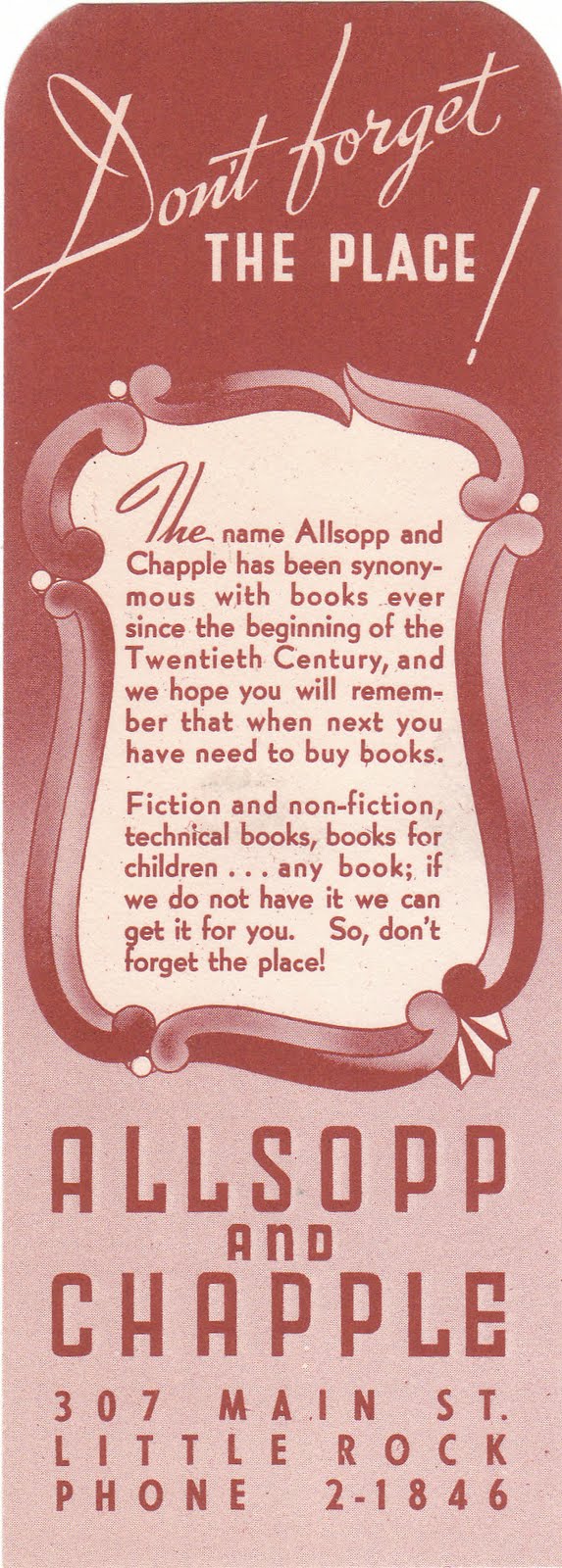
A Little Bookmark in History

I have been reading Mrs. Miniver by Jan Struther, which has been on my TBR pile for several months. I'm thoroughly enjoying this quaint pre-WWII English story including the fact that the book copy I have was published in the 1940s and smells just as an old book should. What I didn't expect to find while reading was an old bookmark. Somewhere around chapter five I came upon the following bookmark and figured it was probably from the seller previous to the seller I bought the book from... then I saw the phone number. I don't know the age, but I'm guessing this book mark dates back to the 1960s simply by the fact the phone number is only numeric and not a mix of alpha and numeric figures.

Further research into the bookstore Allsopp And Chapple in Little Rock, AR led me to the following information:

1. The bookstore no longer exists.
2. It was co-owned by Frederick William Allsopp (June 25, 1867 to April 9, 1946), but was sold in 1919 to a new owner. It was again sold in 1958 and at that time still operated under the original name of Allsopp And Chapple.
3. The "Chapple" in the bookstore name was James Chapple who might have been related to Mary Chapple Allsopp (Frederick's wife??).
3. Born in England, Mr. Allsopp emigrated to the US with his family sometime in the mid to late 1800s.
4. Although never the editor or publisher, Mr. Allsopp was a business manager of the Arkansas Gazette and helped to shape the future of Arkansas newspapers.
5. Mr. Allsopp was a life-long lover of books and eventually published books as well as co-owned the aforementioned bookstore, Allsopp And Chapple, which is said to have been the leading bookstore in the county at that time.

I wasn't able to find out anything more, but still it was fun to stumble upon a bit of history. Holding the bookmark I can't help but ponder the unanswered questions time has turned to mystery. Like, who was the customer was that bought Mrs. Miniver and was it at Allsopp and Chapple? Or did they buy another book and then reuse the bookmark while reading Mrs. Miniver? What was the bookstore like? How old is this bookmark? How did the bookmark end up in a book that was bought by me several states and at least 1,000 miles away?

History can be full of the oddest little mysteries.

Thursday, August 27, 2009

The Diamond in the Window by Jane Langton

242 pages
Copyright 1962
Harper & Row, Publishers
New York, NY

The Diamond in the Window is the first book in the Hall Family Chronicles by Jane Langton. The Chronicles consists of eight books that were published between 1962 and 2008.

The Plot:
Set in Concord, Massachusetts in the present day (present when published in 1962), The Diamond in the Window is a story that involves mystery, romance, adventure, and fantasy. While most of the story is written in prose a few quotes and some poetry is scattered within.

"Eddy and Eleanor Hall have always known that their family was a bit out of the ordinary. After all, they live in one of the most remarkable houses in all of Concord. But they never guessed just how extraordinary their house really is, or what tremendous secrets about their family's past it holds. That is, until they discover the magical attic room with its beautiful stained-glass window, abandoned toys, and two perfectly made-up, empty beds that seem to be waiting perhaps for two children just like themselves...." (Summary courtesy of the publisher)

My Thoughts:
I was intrigued from the first page of The Diamond in the Window. As I quoted earlier this week in my Tuesday Teaser post, the opening paragraphs made for a compelling read. Ms. Langton writes well as a children's storyteller and I found the book both clever and amusing. The characters were fun as well, with some being easily likable and others appropriately despicable. That said, there was a point, about two thirds into the story, where my interest lagged a little. It wasn't really that the story dragged, because it didn't. It had more to do with the fact I wasn't excited to find so much of the story revolved around the 19th century belief of transcendentalism. I kept wondering where Ms. Langton was going with the story and why she focusing on this out-of-date philosophy.

As I read on the answer to these questions became clear. First, it is evident in her writing that Ms. Langton is both fascinated and passionate about Concord, Massachusetts history and its connection with the late 19th century transcendentalist movement. Second, in writing a story that involves beliefs and philosophies from generations past it only makes sense to include some of the local celebrities who played a part in the movement (Enter Louisa May Alcott, Ralph Waldo Emerson, and Henry David Thoreau). In turn these celebrities play a historic part in the story, which ties everything neatly together and makes for a very different type of story.

I was pleased to find when I reached the end of the book that even though Ms. Langton makes the transcendentalist movement a part of her story it isn't the point of her story. There is no "preachiness" in the story, it's just a means to an end. The real point of the story is a tale of mystery and adventure and good overcoming evil. The Diamond in the Window is definitely a fantasy with impossible adventures, some of which are a little weird like a dream... but for the most part the book is just plain fun. It reminds me a great deal of another children's book I read and reviewed, The Enchanted Castle by Edith Nesbit and also a little of a book I started, but never finished, The King in the Window by Adam Gopnik.

My Summary
Overall I can say I enjoyed The Diamond in the Window. It was a fun read, but with a somewhat predictable ending (but probably less so for young readers). On a scale of 1-5, 1 being horrible and 5 being excellent I would rate The Diamond in the Window a 3.5. It was a good read, but I will admit the transcendentalism stuff kind of turned me off from giving the book a higher rating; still I might take a look at the rest of the Hall Family Chronicles at some point in the future. In the meantime, fans of The Enchanted Castle may find a winner in this book.

For more information about the series or about Ms. Langton check out this Wiki article.