Showing posts with label Crime. Show all posts

Wednesday, October 5, 2011

They Came to Baghdad by Agatha Christie

280 pages
Published by Dodd, Mead & Company in 1951
Reprinted in  2002 by St. Martin's Paperbacks of St. martin's Press
New York, NY

I must confess I was a little hesitant when I picked up They Came to Baghdad from my local library. All summer long I had suffered from a sort of reading-funk which has kept me from finishing little more than a dozen books. So when I saw this novel, written by one of my favorite authors, was not one of her more famous "who-dunnit" murder mysteries, but instead a little-known adventure/espionage thriller set in post WWII Iraq I was not thrilled.

But determined to give it a chance (after all I am still endeavoring to read my way through all of Agatha Christie's novels in order of publication) I pressed on. And I am happy to tell you my first impression was wrong!

The Plot:
"Baghdad is holding a secret superpower summit, but the word is out, and an underground organization in the Middle East is plotting to sabotage the talks. Into this explosive situation appears Victoria Jones, a young woman with a yearning for adventure who gets more than she bargains for when a wounded spy dies in her hotel room. The only man who can save the summit is dead. Can Victoria make sense of his dying words: Lucifer…Basrah…Lefarge.…" (Harper Collins Publisher)

My Thoughts:
They Came to Baghdad now ranks as one of my all-time favorite novels by Agatha Christie. As I mentioned above, at first I was rather hesitant in reading this novel. I didn't have high expectations that it would be a thrilling read and I really didn't like the heroine, Victoria Jones, when she first enters the scene. But I kept reading and it wasn't long before I was hooked.

As I mentioned above, They Came to Baghdad is not your average Agatha Christie who-dunnit murder mystery, but instead a post-WWII espionage suspense thriller that include a few murders. The main story is set in Iraq during the early 1950s and while it revolves around Victoria Jones there is plenty of time for "sight-seeing" along the way and Christie makes time for it. At this time in her life, Agatha Christie was married to archaeologist Max Mallowan and spent a great deal of her time with him on digs in the Middle East. Her knowledge of the area and the work is woven seamlessly into this story without detracting from the thrilling story plot.

As the story draws to an end I am happy to report I changed my mind about Victoria Jones. Her character truly matures as the story progresses and as the lose ends are tied up I was delighted with the foreshadowing for Victoria that Christie included in the closing paragraph.

All in all, I must admit I was definitely surprised with this novel. In my opinion it's a definite winner and a top favorite for me. I highly recommend it to those readers who are looking for a variant from the typical English countryside murder mystery or those who love a good spy tale.

Up next, I'll return to Hercule Poirot and the English country village in Mrs. McGinty's Dead.

---------------------------------------------
Related Links:
My Other Agatha Christie Reviews:
*Novels published from 1920-1923 see note below.

The Man in the Brown Suit (1924)
The Secret of Chimneys (1925)
The Big Four (1927)
The Mystery of the Blue Train
(1928)
The Seven Dials Mystery (1929)
The Murder at the Vicarage
(1930)
The Sittaford Mystery (1931)
Peril at End House
(1932)
Lord Edgware Dies
(1933)
Murder on the Orient Express (1934)
Why Didn't They Ask Evans?
(1934)
Three Act Tragedy (1935)
Death in the Clouds
(1935)
The A.B.C. Murders (1936)
Murder in Mesopotamia (1936)
Cards on the Table
(1936)
Dumb Witness
(1937)
Death on the Nile (1937)
Appointment With Death (1938)
Hercule Poirot's Christmas (1938)
Murder Is Easy (1939)
And Then There Were None (1939)
Sad Cypress (1939)
One, Two Buckle My Shoe (1940)
Evil Under the Sun (1941)
N or M? (1941)
The Body in the Library (1942)
Five Little Pigs (1942)
The Moving Finger (1942)
Towards Zero  (1944)
Death Comes As the End (1944)
Sparkling Cyanide (1945)
The Hollow (1946) 
Taken At the Flood (1948) 
Crooked House (1949) 
A Murder is Announced (1950)

Absent In the Spring by Mary Westmacott (a.k.a. Agatha Christie) (1944)

Agatha Christie, An Autobiography

* Christie's novels written from 1920 (The Mysterious Affair at Styles) through 1923 (Murder on the Links) I read before I began this blog hence no reviews are currently available.

Sunday, August 28, 2011

Gaudy Night by Dorothy L. Sayers


501 pages
Published 1935 by Gollancz
Reprinted by Harper Collins Publishers in 1995
New York, NY

It's no secret, I love a good mystery read. And yet somehow I had managed to get nearly three decades into my life with books without once picking up a novel by Dorothy L. Sayers. That is, until this year when several of the ladies in my book club strongly encouraged our group to not only read Gaudy Night, but to add it to the very limited list of books we read and discuss together. I knew then and there I had to read something by Dorothy L. Sayers. A book coming with such strong recommendation from readers I respect and admire, I knew must be indeed a worthwhile read.

For those that don't know much about Sayers' mystery novels, Gaudy Night is the tenth book in the Lord Peter Wimsey detective series. It varies slightly from the earlier books in the series in that the plot revolves around mystery author Harriet Vane, a friend of Lord Peter's, with Lord Peter taking a supporting role to the story. Having absolutely no background in either the character's lives or the previous cases solved within the series I thought I might be in for a bit of confusion, but I was not. Although references to earlier cases, particularly Strong Poison are made, these are subtle and do not distract from the present story. In a way, Gaudy Night could probably be considered one of the few stand-alone reads within a series if one chose to read it that way.

The plot:
Famed mystery writer Harriet Vane returns to her alma mater (an all female college) for reunion of sorts, which will include the annual "Gaudy" celebrations. Harriet initially has second thoughts about making the trip, but after the weekend turns out well she quickly dismisses such thoughts... Until she  discovers a poison-pen type note in the pocket of her gown that she wore during her stay. This she soon learns is not the only one of its kind. The dons of the college contact Harriet asking for her assistance in solving a real mystery -- who is the lunatic behind a string of malicious pranks, poison pen letters and nasty graffiti that has been spread around the college following the Gaudy Night. The only problem is the dons want to keep the matter out of the press and yet there is a sense of urgency that the mystery must be solved before someone is seriously injured... Hoping to avoid scandal and further problems Harriet begins to investigate, but quickly turns to her friend Lord Peter Wimsey for help in clearing the names of some of her beloved teachers.

My Thoughts:
I truly enjoyed Gaudy Night. It was a good mystery read. Although, I confess, I did solve the "whodunnit" about 125 pages before the end, which I count an accomplishment as the mystery was a definite puzzler. I found the story well plotted, well written, and overall fascinating on so many levels.

On the surface you have a mystery. Below that there are discussions and thought provoking conversations that revolve around issues of the day like social class, feminism, a woman's education, and the advantages of marriage and single-hood, career and family. Of course to further enrich this novel there is also a love story and plenty of charm and wit to keep the reader laughing and turning the pages.

Yes, this is a Harriet Vane story, but it is contained within the Lord Peter Wimsey series and Lord Peter's presence is certainly felt within the book even when he is physically absent from the scene. It didn't take long before I knew I had to read the rest of the series. I just loved Lord Peter and Harriet Vane.

Gaudy Night is a quotable, meaty story, but also a thrilling and completely satisfying mystery. Definitely a must-read for mystery fans or those looking for a good English read from the early part of the 20th century, but don't just take my word for it, go get a copy and discover for yourself!

------------------------
Related Links:

Thursday, August 25, 2011

The Red House Mystery by A. A. Milne

239 pages
Published in 1922 by E. P. Dutton & Company


I don't recall now where or when I first learned of The Red House Mystery. I might have stumbled upon it while looking for an audio book to listen to during a long flight delay. Or it is possible I found it while perusing the list of books written by one of the world's most cherished children's authors, A. A. Milne. Because, of course when you hear the name A. A. Milne the stories of a rolly-polly bear named Winnie-the-Pooh, Christopher Robin, and the friends within the Hundred Acre Wood are what first come to mind. And because of this I never gave Milne more than a passing thought. Yes, I planned to read all the Winnie-the-Pooh stories to my daughter when she was old enough, but it never occurred to me that Milne might have penned any novels for an adult audience.

And then I discovered The Red House Mystery. It is one of Milne's earliest novels and also his only detective/mystery novel. Published in 1922, The Red House Mystery predates the Winnie-the-Pooh stories by four years. It appears to have been written purely for fun and the enjoyment of Milne's father, who loved a good mystery.

The plot:
"The setting is an English country house, where Mark Ablett has been entertaining a house party consisting of a widow and her marriageable daughter, a retired major, a wilful actress, and Bill Beverley, a young man about town. Mark's long-lost brother Robert, the black sheep of the family, arrives from Australia and shortly thereafter is found dead, shot through the head. Mark Ablett has disappeared, so Tony Gillingham, a stranger who has just arrived to call on his friend Bill, decides to investigate. Gillingham plays Sherlock Holmes to his younger counterpart's Doctor Watson; they progress almost playfully through the novel while the clues mount up and the theories abound." (summary courtesy of Wikipedia)

My Thoughts:
I thoroughly enjoyed The Red House Mystery from the first page to the last. It was a mix of clever clues, puzzling problems, and plenty of tongue-in-cheek humor. There were a few suspenseful scenes and the ending was fully acceptable, albeit I admit a tad bit predictable (at least to me an avid fan of whodunit mysteries). Still, when I finished reading this little-known mystery novel I felt as if I'd stumbled upon a hidden gem.
 
I read somewhere that A. A. Milne did not like to be pigeon-holed into one specific genre of books, hence why during his life-time he wrote such a variety of books, plays, and poems. My only regret in discovering this gem of a novel is that it is the only one of its kind amongst Milne's works. The Red House Mystery was a worthwhile and thoroughly enjoyable read and I highly recommend it to any reader looking for a new mystery to solve or to discover another side to Milne's creative mind.

------------------------
Related Links:

Tuesday, June 14, 2011

The Hollow by Agatha Christie

288 pages
Published in 1946 by Dodd, Mead & Company
Reprinted in 2007 by Black Dog & Leventhal Publishers

The Hollow is the 37th crime novel by Agatha Christie and the 22nd to include Hercule Poirot as lead detective. It also marks the return of Poirot after a four year absence (1942-1946).

The Plot:
"Lady Angkatell, intrigued by the criminal mind, has invited Hercule Poirot to her estate for a weekend house party. The Belgian detective's arrival at the Hollow is met with an elaborate tableau staged for his amusement: a doctor lies in a puddle of red paint, his timid wife stands over his body with a gun while the other guests look suitably shocked. But this is no charade. The paint is blood and the corpse real!" (Summary courtesy of AgathaChristie.com)

My Thoughts:
Overall I enjoyed The Hollow. It is similar to Sparkling Cyanide in that the story holds true to the traditional Christie "who-dunit" mystery with the murder set in the heart of the English countryside, a house party, and a shocking murder. The story plot itself is a twisting puzzle complete with a red herring or two and plenty of interesting characters. I particularly enjoyed the return of Hercule Poirot since it has been months since I last encountered him (Five Little Pigs) and have felt his absence in a few of the Christie novels I've read in the interim.

What I liked best about The Hollow was the fact that even though it has a similar setting to other Christie mysteries and even though the motive isn't exactly unique the story still felt fresh. I found myself puzzling out the answer to the mystery until the last chapters. The only aspect that keeps The Hollow from being a high-rated favorite for me was the combined fault of of the characters and the plot. I never attached myself to any one particular character, thus I was not pulled emotionally into the story, which left me feeling somewhat indifferent to the ending. As for the plot, I was stumped for a time, but not completely. Had it left me guessing to the very end and had I found an attachment with a character I might have loved this story, but as it stands it is in my opinion a mid-level mystery from Agatha Christie's collection. A good puzzling read, but not a complete thriller.

Up next, Taken At the Flood.

------------------------------
Related Links:
Other Agatha Christie Reviews:
*Novels published from 1920-1923 see note below.

The Man in the Brown Suit (1924)
The Secret of Chimneys (1925)
The Big Four (1927)
The Mystery of the Blue Train
(1928)
The Seven Dials Mystery (1929)
The Murder at the Vicarage
(1930)
The Sittaford Mystery (1931)
Peril at End House
(1932)
Lord Edgware Dies
(1933)
Murder on the Orient Express (1934)
Why Didn't They Ask Evans?
(1934)
Three Act Tragedy (1935)
Death in the Clouds
(1935)
The A.B.C. Murders (1936)
Murder in Mesopotamia (1936)
Cards on the Table
(1936)
Dumb Witness
(1937)
Death on the Nile (1937)
Appointment With Death (1938)
Hercule Poirot's Christmas (1938)
Murder Is Easy (1939)
And Then There Were None (1939)
Sad Cypress (1939)
One, Two Buckle My Shoe (1940)
Evil Under the Sun (1941)
N or M? (1941)
The Body in the Library (1942)
Five Little Pigs (1942)
The Moving Finger (1942)


* Christie's novels written from 1920 (The Mysterious Affair at Styles) through 1923 (Murder on the Links) I read before I began this blog hence no reviews are currently available.

Wednesday, June 8, 2011

Sparkling Cyanide by Agatha Christie

278 pages
Published in 1945 by G. P. Putnam's Sons
Reprinted in 2011 by St. Martin's Paperbacks
"At a round table in the Luxembourg nightclub six people sit down to dinner at a table laid for seven. In front of the empty place is a sprig of rosemary – in solemn memory of Rosemary Barton who died at the same table exactly one year previously. No one present on that fateful night would ever forget the woman’s face, contorted beyond recognition – or what they remembered about her astonishing life. But which of those present has the murder of Rosemary Barton on their conscience?" (Summary courtesy of AgathaChristie.com)
Sparkling Cyanide is a classic Agatha Christie mystery novel and for that fact alone I enjoyed it. It's a quick and entertaining read that left me puzzling out the answer until nearly the end. That said, I can't say that Sparkling Cyanide was outstanding amongst all of Agatha Christie's novels. I felt it followed pretty much the same plot formula that she used for several of her earlier works and it left me with a feeling of familiarity that I couldn't quite put my finger on, as if I had read the story already.

During further reading I discovered that prior to publishing Sparkling Cyanide, Agatha Christie actually used the plot in a short story titled Yellow Iris. The differences between the short story and the novel are few, but they are important. When writing Sparkling Cyanide Christie removed Hercule Poirot entirely making Colonel Race the central detective, and she changed the identity of the murder (or murderers) so to give the feeling of a fresh story... and it sort of works. For those who have never read Yellow Iris it is a new story, but somehow even without reading Yellow Iris the whole book felt familiar.

All in all, if you're looking for an entertaining "who-dunit" from the Queen of Crime, this one will definitely pass for a fast and fun read, but if you're looking for something thrilling and fresh, in my opinion it's best to try one of her earlier works.

Up next, The Hollow.

-----------------------------------
Related Links:
Other Agatha Christie Reviews:
*Novels published from 1920-1923 see note below.

The Man in the Brown Suit (1924)
The Secret of Chimneys (1925)
The Big Four (1927)
The Mystery of the Blue Train
(1928)
The Seven Dials Mystery (1929)
The Murder at the Vicarage
(1930)
The Sittaford Mystery (1931)
Peril at End House
(1932)
Lord Edgware Dies
(1933)
Murder on the Orient Express (1934)
Why Didn't They Ask Evans?
(1934)
Three Act Tragedy (1935)
Death in the Clouds
(1935)
The A.B.C. Murders (1936)
Murder in Mesopotamia (1936)
Cards on the Table
(1936)
Dumb Witness
(1937)
Death on the Nile (1937)
Appointment With Death (1938)
Hercule Poirot's Christmas (1938)
Murder Is Easy (1939)
And Then There Were None (1939)
Sad Cypress (1939)
One, Two Buckle My Shoe (1940)
Evil Under the Sun (1941)
N or M? (1941)
The Body in the Library (1942)
Five Little Pigs (1942)
The Moving Finger (1942)


* Christie's novels written from 1920 (The Mysterious Affair at Styles) through 1923 (Murder on the Links) I read before I began this blog hence no reviews are currently available.

Saturday, March 5, 2011

Towards Zero by Agatha Christie

276 pages
Published by G. P. Putnam’s Sons in 1944
Reprinted in 2001 by St. Martin’s Paperbacks
New York, NY

“I love a good detective story, but they begin in the wrong place! They begin with the murder. But the murder is the end. The story begins long before that." ~ Towards Zero by Agatha Christie
The Plot:
"What is the connection between a failed suicide attempt, a wrongful accusation of theft against a schoolgirl, and the romantic life of a tennis player? To the casual observer, apparently nothing. When a houseparty gathers at Gull's Point, the seaside home of an elderly widow, earlier events come to a dramatic head." (Summary courtesy of AgathaChristie.com.)

My Thoughts:
I actually read Towards Zero at the beginning of December 2010, but with some unexpected changes to my life I wasn't able to review it and one thing led to another until I realized it was almost March and I hadn't even marked the book "read" on my virtual book shelf! Thankfully I keep notes on nearly all the books I read, so refreshing my memory for this review wasn't too difficult even though now nearly four months had elapsed. But please note, my forgetfulness should not in any way reflect upon the book. Towards Zero is a thrilling read that left me guessing up until the very end... To that zero hour.

Although a completely fresh story and setting, I did find that Towards Zero was a little reminiscent of one of Christie's earlier works, And Then There Were None, except for the blessed fact that this story ends on a much happier note than its predecessor thanks to the clever mind of Superintendent Battle.

And speaking of Battle, I found it interesting that Towards Zero is one of only five Christie mystery novels to feature the Superintendent as lead investigator. Another interesting fact is that it is also the last novel to feature him at all. Clearly by the mid 1940s Hercule Poirot was the front-runner in detective stories and it appears other detectives (i.e. Colonel Race, Miss Marple, Tommy & Tuppence, etc.) only made appearances at times when Christie really needed a vacation from the Belgian and his little gray cells.

As noted Towards Zero was published in 1944, which was the middle to end of World War II. While I always enjoy a Christie mystery I've found that this decade wasn't exactly her best. Looking back over the 34 novels she had written by this point most of my favorites actually date from the previous decade, the 1930s. But if I were to pick one with in the 1940s that I enjoyed as much as Towards Zero it would have to be N or M? Still, there are five more novels to read and review before moving into the 1950s so I suppose there's still a chance I could change my mind.

In the meantime, I definitely recommend Towards Zero as a mystery read. It has an excellent story plot, an interesting setting and array of characters, and an exciting and somewhat challenging psychological puzzle to solve. In summary, it is clever enough to feed your thirst for thrills yet not so great that you won't find yourself passing up the chance to read more novels by the Queen of Crime.

Up next, Death Comes As The End.

----------------------------------
Other Agatha Christie Reviews:
*Novels published from 1920-1923 see note below.

The Man in the Brown Suit (1924)
The Secret of Chimneys (1925)
The Big Four (1927)
The Mystery of the Blue Train
(1928)
The Seven Dials Mystery (1929)
The Murder at the Vicarage
(1930)
The Sittaford Mystery (1931)
Peril at End House
(1932)
Lord Edgware Dies
(1933)
Murder on the Orient Express (1934)
Why Didn't They Ask Evans?
(1934)
Three Act Tragedy (1935)
Death in the Clouds
(1935)
The A.B.C. Murders (1936)
Murder in Mesopotamia (1936)
Cards on the Table
(1936)
Dumb Witness
(1937)
Death on the Nile (1937)
Appointment With Death (1938)
Hercule Poirot's Christmas (1938)
Murder Is Easy (1939)
And Then There Were None (1939)
Sad Cypress (1939)
One, Two Buckle My Shoe (1940)
Evil Under the Sun (1941)
N or M? (1941)
The Body in the Library (1942)
Five Little Pigs (1942)
The Moving Finger (1942)

Absent In the Spring by Mary Westmacott (a.k.a. Agatha Christie) (1944)

Agatha Christie, An Autobiography

* Christie's novels written from 1920 (The Mysterious Affair at Styles) through 1923 (Murder on the Links) I read before I began this blog hence no reviews are currently available.

Thursday, October 21, 2010

Five Little Pigs by Agatha Christie

216 pages
Published in 1942
by G. P. Putnam's Sons
reprinted by Berkley Books in 1984
New York, NY


I love reading a fresh story and Five Little Pigs by Agatha Christie (also published in the USA as Murder in Retrospect) is certainly that. Five Little Pigs, one of Christie's little-known Poirot novels is also the first novel where the murder occurs in the past; in retrospect to the detecting by Poirot. This alone makes it a unique read for Christie fans.

The Plot:
"Amyas Crale's passion for painting and women made him famous. His murder made him infamous. Sixteen years earlier his jealous wife was tried, convicted and sentenced to life for a notorious slaying. Now their daughter Carla, a young woman convinced her mother is innocent, has presented Hercule Poirot with a brilliant challenge: to clear her mother's name by returning to the scene of the murder and finding the fatal flaw in the perfect crime." (Summary courtesy of AgathaChristie.com)

My Thoughts:
Five Little Pigs was a captivating and quick read. As I read several clues seemed to jump off the page. Maybe this is due to the fact I just finished reading Agatha's autobiography last month, or maybe I've just read enough of her books to pay attention to the details that matter. Either way it was a fun read and although it is a tricky mystery I puzzled through drawing conclusions and in the end I was pleased to find led me to solve the "who" and "why" before Poirot had a chance to assemble the witnesses and begin his methodical recreation of the crime. I count this a victory for me as a reader even if I missed a few minor details.

Something else that I noticed while reading was the little bits of Agatha's personality sprinkled throughout the story. Intended or not, these details appear in the form of certain character personalities or in observations and opinions made by the characters or in some cases the unseen narrator. The two strongest examples both involve Hercule Poirot. At one point Poirot contemplates the the frequency in which he encounters crimes with a nursery rhyme theme (i.e. One, Two Buckle My Shoe and now Five Little Pigs). This was something Agatha Christie also observed within her autobiography. Another such instance is when Poirot remarks on his preference for psychological crimes versus those revolving around a romance, which was popular amongst readers and publishers. Again, this was how Agatha felt. While I must admit to personally enjoying the relational aspect of her mysteries it was in her mind a disruption to the scientific aspect of the crime to include the distraction of a romance.

Overall I really enjoyed Five Little Pigs. For some writers it would be difficult to tell a story where the main event occurs 16 years in the past, but Agatha is successful in weaving the past and present together to give readers yet another entertaining and suspenseful mystery.

Up next, Miss Marple in The Moving Finger.

----------------
Click here to read my other reviews of Agatha Christie novels.

Sunday, September 5, 2010

The Body In the Library by Agatha Christie

191 pages
Published in 1942 by G. P. Putnam's Sons
Reprinted in 2006 by Black Dog & Leventhal Publishers, Inc.
New York, NY


I'm fairly certain I have read The Body in the Library once before, a long time ago, but I do not remember exactly when and I could not remember anything about the story, which made this re-read just as enjoyable as if I'd never before set eyes on the book.

Although The Body in the Library does not rank as one my all-time favorite mysteries by Agatha Christie it is an excellent read, a page-turning mystery and I definitely agree with what Agatha Christie said in a Time magazine article in 1956 that it is has the best opening to a book she has ever written.

The Plot:
"Colonel and Mrs. Bantry are shocked when they wake one morning to find the dead body of a young platinum blonde on the floor of their library. Nobody in the village of St. Mary Mead seems to know who she is, but everyone has a theory about the crime. The ensuing investigation follows a twisted trail from this quiet village to an upscale hotel in the nearby town of Danemouth, where the victim worked as a ballroom dancer and bridge hostess. As the local inspectors sift through emerging clues to identify a suspect, Miss Jane Marple, St. Mary Mead's resident sleuth, always seems to be one step ahead of them." (Summary courtesy of the publisher)

My Thoughts:
As I mentioned in my review of N or M? Agatha Christie actually wrote The Body in the Library at the same time she was writing N or M? It was the early years of World War II and Agatha Christie was living alone in London while her second husband Max Mallowan was serving in the Royal Air Force Volunteer Reserve in North Africa.

Unlike N or M? this novel is pure "Who-dun-it". International spies, the threat of German invasion, food rations, gas masks and blackout curtains have no place in the little town of Saint Mary Mead. It's as if Christie set the story a few years in the past when England was full of life and parties were plenty. I imagine The Body in the Library, although a murder mystery, must have been a relief in a way for readers. While reading this novel they could put out of their mind all thoughts of war and focus on the puzzle set before them.

Although not present in the edition I read, earlier copies of The Body in the Library included an author's foreword where Christie described "the body in the library" as a cliche of detective fiction. But as typical of her excellence as a story teller Agatha Christie she didn't leave it at that. She created a variation on this theme -- she decided that while the library should be completely conventional the body must be highly improbably and sensational. And it works. Many readers consider The Body in the Library to be a parody of sorts, poking fun at the detective fiction genre. But of course it is more than that. Christie weaves a mix of spine-tingling danger and comic relief in a story that keeps you reading late into the night.

The Body in the Library is only the second novel to include Miss Jane Marple as detective. Perhaps that is why I have yet to feel as emotionally attached to Miss Marple as a character like I have with Hercule Poirot. Although Miss Marple makes the occasional appearance in short stories between 1927 and 1942 she doesn't appear in a novel after her first, The Murder at the Vicarage in 1930 until this one over a decade later. It is also interesting to note that while Miss Marple is the one who solves the mystery of the body in the library, she only makes occasional appearances in the story and to the casual reader it would appear she won't be the one to solve the case... until all of a sudden she does. How different Miss Marple is to Hercule Poirot. Some of this has to do with the difference in personalities and some if I think has to do with the fact that Agatha Christie was still working on developing Miss Marple as a character when she wrote The Body in the Library. Whereas with Poirot by the 1940s she had already included him in over twenty novels and several short-stories. From the 1940s on Miss Marple take a more central role in the mysteries that Christie wrote. I am curious to see how her character develops from book to book and if I will find myself eventually preferring her to Poirot.

The Body in the Library has been adapted to film only twice. The first time was in 1984 with actress Joan Hickson playing the role of Miss Marple. Although an older adaptation (nearly 20 years) this version is faithful to the original novel. The second adaptation was released in 2004 with Geraldine McEwan in the lead role as Miss Marple. Unfortunately this adaptation is less-faithful to the book with many additions and subtractions from the original plot, including a complete change in motive and murderer. To add insult to injury the screenwriters included a relationship twist that was not part of the book and appears to be added just to appeal to modern viewers. Personally if I had to choose between these two adaptations I would pick the former over the latter version. I prefer a faithful adaptation to anything modern.

Up next: Hercule Poirot returns in Five Little Pigs also published as Murder in Retrospect.

Thursday, August 26, 2010

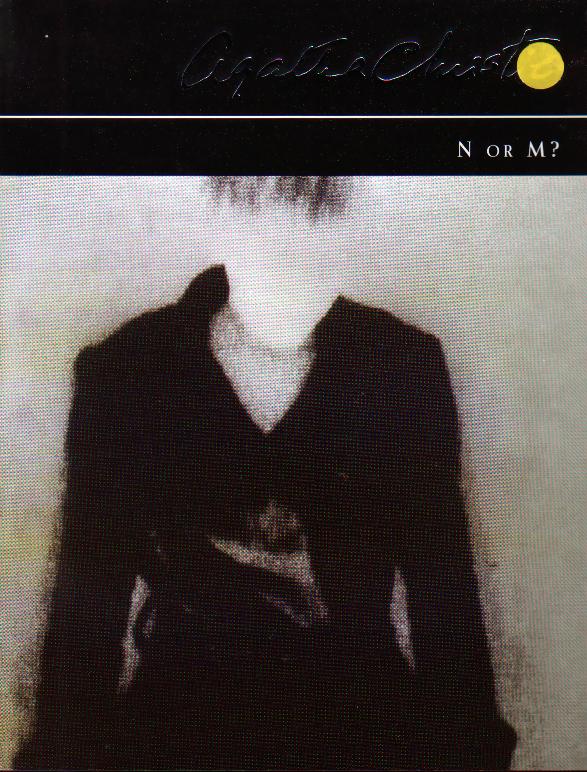
N or M? by Agatha Christie

202 pages
Published in 1941by Dodd, Mead & Co.
Reprinted in 1988 by Bantom Books
Hicksville, NY


Ask just about any reader to name one of Agatha Christie's detectives and I'm sure you'll hear the names Miss Marple and Hercule Poirot. But if they mention the names Tommy Beresford and Tuppence Cowley, then you know you are talking with an avid Christie fan. Agatha Christie's Tommy and Tuppence stories only total four novels and one short story over the span of 51 years whereas Hercule Poirot appeared in no less than 33 novels and 51 short stories during that same span of time.

Tommy and Tuppence are first introduced in Christie's second novel, The Secret Adversary** published in 1922. The pair then made one more, albeit brief, appearance in the 1929 short story Partners in Crime before fading so far to the background of Agatha Christie's writing that they disappear completely for nearly two decades. It is not until 1941 during the midst of World War II that Tommy and Tuppence return in the spy thriller N or M?

I can only imagine the excitement Christie fans must have felt when they learned she had written another Tommy & Tuppence story. Finally after nearly twenty years we get to enjoy another thrilling adventure with this duo and finally find out where they have been and what they have been doing for the last 20 years! Well, that's what I imagine fans must have thought -- it's what I thought and I only had 1.5 years of waiting.

(** Unfortunately I read The Secret Adversary before I began this blog so I do not have a review written that I can refer you to. It was an excellent story and a must if you plan to read any of the Tommy and Tuppence books.)

N or M? -- The Plot:
"This atmospheric story, set during World War Two, finds Tommy and Tuppence doing what they do best – having an adventure. These unlikely Intelligence Service spies decide to help Queen and country by tracking down two ruthless traitors. The only clue to the traitors’ identities is a government agent's dying words that lead them to the Sans Souci boarding house, where it’ll take some extremely subtle detection work to establish which of the guests are the treacherous N and M." (Summary courtesy of AgathaChristie.com)

My Thoughts:
I found N or M? to be just exactly what I had hoped -- a thrilling spy novel that contained all the elements that make a novel a delight to read. There was suspense and mystery, there was comedy and sweetness, there was adventure and villainy. As for Tommy and Tuppence, they may have aged some, but they were every bit as endearing to me in this story as they were in The Secret Adversary. I especially liked the fact that Christie let them grow up and mature. They weren't reckless youths anymore, nor where they stodgy middle-aged couple. They were themselves -- intelligent, adventurous, and witty, but also a tad wiser and maybe with a gray hair or two.

If I had to compare Tommy and Tuppence to another fictional pair I would pick Nick and Nora Charles from the Thin Man movies (NOT the book), although with a lot less alcohol. I loved Nick and Nora in the Thin Man movies. There was something about their characters -- their wit and sarcasm and how they related to each other that made them a delightful couple. I have the same feeling when I read about Tommy and Tuppence in N or M? They make for an entertaining read.

As for the mystery itself -- Christie scores again! I picked up on numerous clues, but didn't know how they fit together until they were revealed. And as I drew closer to the end of the book I couldn't put it down. In the end I was up very late reading and thinking to myself, "How is it possible for one woman to write so many excellently thrilling stories?" There is a reason that I am such an avid fan of Agatha Christie and that she is the all-time best selling mystery writer. She was such a creative and clever storyteller.
N or M? may not be her best work, but it's definitely an excellent read and shows what a diverse novelist she was. Too bad there hasn't been a Masterpiece adaptation.

Here are a few interesting facts about N or M?:

*
The title of this book: N or M? plays a central role in the story, but it originated from a catechism in The Book of Common Prayer, which asks, "What is your Christian name? Answer N. or M."

* N or M? is one of two books that Agatha Christie wrote during the midst of World War II when she lived alone in London. The other novel was The Body in the Library, the second Miss Marple mystery. Christie was quoted as saying that she alternated her writing between N or M? and The Body in the Library in order to keep herself "fresh at task."


What's next in my Agatha Christie reading challenge?:
The Body In the Library. Stay tuned.

--------------------------------
Other Agatha Christie Reviews:
*Novels published from 1920-1923 see note below.

The Man in the Brown Suit (1924)
The Secret of Chimneys (1925)
The Big Four (1927)
The Mystery of the Blue Train
(1928)
The Seven Dials Mystery (1929)
The Murder at the Vicarage
(1930)
The Sittaford Mystery (1931)
Peril at End House
(1932)
Lord Edgware Dies
(1933)
Murder on the Orient Express (1934)
Why Didn't They Ask Evans?
(1934)
Three Act Tragedy (1935)
Death in the Clouds
(1935)
The A.B.C. Murders (1936)
Murder in Mesopotamia (1936)
Cards on the Table
(1936)
Dumb Witness
(1937)
Death on the Nile (1937)
Appointment With Death (1938)
Hercule Poirot's Christmas (1938)
Murder Is Easy (1939)
And Then There Were None (1939)
Sad Cypress (1939)
One, Two Buckle My Shoe (1940)
Evil Under the Sun (1941)

Absent In the Spring by Mary Westmacott (a.k.a. Agatha Christie) (1944)

* Christie's novels written from 1920 (The Mysterious Affair at Styles) through 1923 (Murder on the Links) I read before I began this blog hence no reviews are currently available.

Thursday, August 12, 2010

Evil Under the Sun by Agatha Christie

182 pages
Published in 1941 by Dodd, Mead & Company
Reprinted by Bantam Books, April 1988
Hicksville, NY


"It is peaceful. The sun shines. The sea is blue. But you forget, Miss Brewster, there is evil everywhere under the sun." (Chpt 1, pg 8)
The Plot
"Hercule Poirot is enjoying a well-deserved holiday on Smugglers’ Island holiday resort off the coast of Devon until the strangled body of glamorous actress Arlena Stuart is found. As Poirot becomes caught up in the murder investigation he discovers that nearly all the guests have a connection to Arlena. But which of these suspects, including her family, felt strongly enough about Arlena to kill her?" (Summary courtesy of
AgathaChristie.com)

My Thoughts:
What better setting for a thrilling "who-dun-it" crime novel than a sea-side vacation spot where the beautiful and popular, yet most hated person present is murdered? And who better to solve this mystery than the renowned Belgian detective Hercule Poirot? If you are looking for a riveting beach read this summer than Evil Under the Sun might be just the book.

I know it is a well known fact that Agatha Christie found Hercule Poirot quite annoying and boorish, but I have to admit I feel quite the opposite. Although I do enjoy the other detectives Mrs. Christie created, I have a special place in my mystery-loving heart for the Belgian detective and his little grey cells. And once again, in this his 20th appearance in 29 consecutive novels, he does not disappoint.

As is typical of Christie novels I was successful in picking up and piecing together several clues throughout the story, but I was unable to piece them all together before the end when all is revealed by Poirot. I've ceased to find this annoying and instead sit back and chuckle at how clever Agatha Christie was as a mystery writer. Although there may be characters, places, or aspects of her novels that link one to another, each mystery is its own story and a fresh and interesting puzzle awaits me no matter which novel I've chosen to read. I suppose this should not come as a surprise, Christie is after all the "Queen of Crime" and best-selling mystery writer of all time.


As a side note, I couldn't resist this pop-culture reference. Within the TV show LOST (ABC, 2004-2010) the character Sawyer is seen reading numerous books. In one particular episode, if you look closely you'll find him sitting on the beach reading none other than Agatha Christie's Evil Under the Sun. Cool, right? Yeah, I thought so too.

And while on the topic of television -- I watched the 2001 adaptation of Evil Under the Sun with David Suchet as Hercule Poirot. As I've found to be typical of all modern adaptations to Christie's novels there were some liberties taken with the original story. Some characters and scenes were added, including the appearance of Hastings and Chief Inspector Japp as well as the whole motive for Poirot even being on vacation. In addition some of the suspects were altered, some left out entirely and others merged together into a new form entirely. But thankfully the main plot and the who, what, how and why remained the same.

Although I always lean towards recommending the book over the movie I have to say this time it's almost a tie. Yes, the book is the better of the two, but for the average reader (and yes, even the obsessed LOST fan) looking for a different type of beach read or the average mystery lover desiring some movie to entertain on a hot summer evening -- either way you won't go wrong with Evil Under the Sun.

As for me, what's next? Tommy and Tuppence return after two decades in N or M? Stay tuned for my thoughts on this WWII spy thriller.

-----------------------------
Other Agatha Christie Reviews:
*Novels published from 1920-1923 see note below.

The Man in the Brown Suit (1924)
The Secret of Chimneys (1925)
The Big Four (1927)
The Mystery of the Blue Train (1928)
The Seven Dials Mystery (1929)
The Murder at the Vicarage (1930)
The Sittaford Mystery (1931)
Peril at End House (1932)
Lord Edgware Dies (1933)
Murder on the Orient Express (1934)
Why Didn't They Ask Evans? (1934)
Three Act Tragedy (1935)
Death in the Clouds (1935)
The A.B.C. Murders (1936)
Murder in Mesopotamia (1936)
Cards on the Table (1936)
Dumb Witness (1937)
Death on the Nile (1937)
Appointment With Death (1938)
Hercule Poirot's Christmas (1938)
Murder Is Easy (1939)
And Then There Were None (1939)
Sad Cypress (1939)
One, Two Buckle My Shoe (1940)


Absent In the Spring by Mary Westmacott (a.k.a. Agatha Christie) (1944)

* Christie's novels written from 1920 (The Mysterious Affair at Styles) through 1923 (Murder on the Links) I read before I began this blog hence no reviews are currently available.